

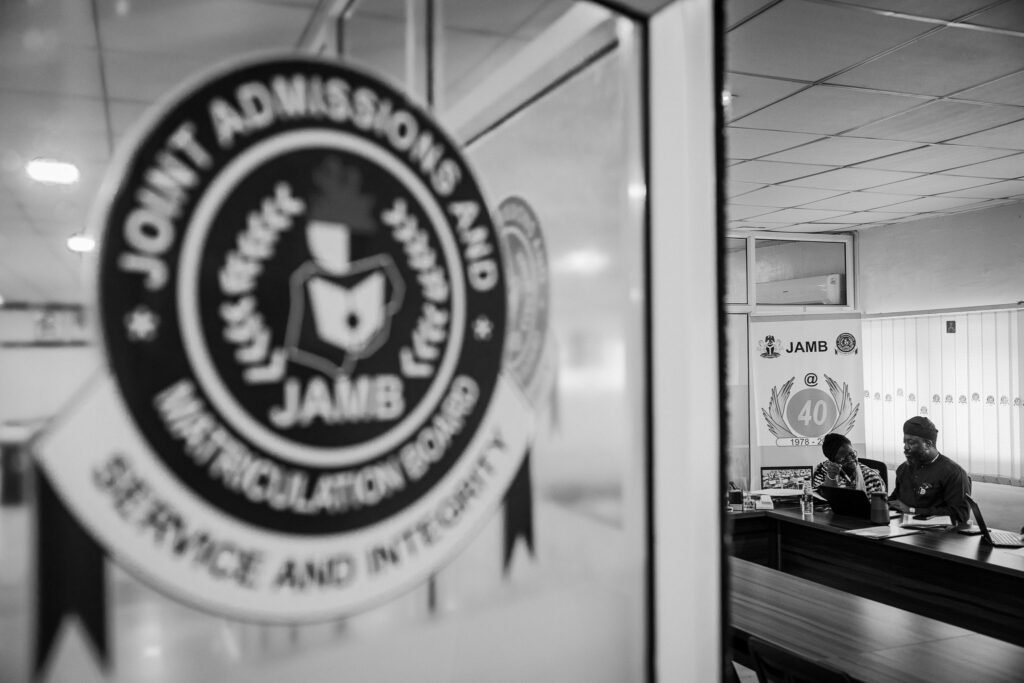
On 5 October 2026, the Joint Admissions and Matriculation Board (JAMB) announced plans for a UTME centre in Ottawa, Canada, to open in 2027. The Board said the centre will allow eligible Nigerians in Canada and across North America to sit the Unified Tertiary Matriculation Examination without travelling to Nigeria. Easing access for Nigerians abroad is a reasonable goal. The difficulty is that JAMB has run foreign examination centres since at least 2013 without publishing how many candidates use them, what they cost, or what they achieve.
The Ottawa decision therefore points to a broader gap. JAMB’s expansion abroad lacks a published evidence base, performance measures, and a public accountability framework.
Legally, the JAMB Act supports the Ottawa centre because Section 5 directs the Board to conduct the matriculation examination for entry into universities, polytechnics, and colleges of education in Nigeria. The Act links the examination to the institution a candidate seeks to enter, not to where the candidate lives. A Nigerian student in Ottawa who applies to a Nigerian university falls within JAMB’s mandate.
The harder question concerns a second objective. JAMB’s own statements describe the foreign programme as a tool for recruiting international students. In 2019, JAMB set up a committee on internationalisation, chaired by Professor Attahiru Jega, which recommended a national framework for internationalising Nigerian tertiary education. In 2022, JAMB said its international test administration policy aims to attract more foreign candidates to Nigerian institutions. In July 2024, JAMB stated that the foreign examination aims to showcase Nigerian tertiary institutions to a global audience. In the same statement, JAMB reported that it had made the number of foreign students an institution admits a criterion for its NATAP M-Award. The public record does not show which of the Jega committee’s recommendations JAMB adopted.
Diaspora access and international recruitment are different policies. Diaspora access serves Nigerians who already intend to study at home, and its success depends on uptake and cost. International recruitment brings non-Nigerian students to Nigerian campuses, and its success depends on visas, campus security, fees and teaching quality. Those matters sit mainly with the Federal Ministry of Education, the National Universities Commission (NUC), the Nigeria Immigration Service and the Ministry of Foreign Affairs. The JAMB Act does not expressly assign recruitment to JAMB, and no published ministerial directive does so.
The public record on the foreign programme is thin and inconsistent. In 2013, the UTME was held in six foreign cities. In 2022, JAMB reported nine foreign centres, including Berlin and New York. By July 2024, JAMB listed eight cities, and neither Berlin nor New York was among them. Banjul appeared on the list for the first time. JAMB has not explained when each centre opened or closed, or why.
Candidate data is even harder to find. JAMB reports foreign registrations within its national totals. In 2019, the then Registrar, Professor Is-haq Oloyede, stated that the 1,886,508 registered candidates included those at foreign centres. In 2024, JAMB reported 1,989,668 registered candidates without a separate figure for foreign centres. JAMB has stated that the foreign programme has attracted international students to Nigerian universities, but it has not published the figures. JAMB has not published how many foreign-centre candidates were admitted, enrolled or graduated. It has not published the cost of any foreign centre or stated who pays for it.
Demand for a Canadian centre is plausible but undocumented. Statistics Canada reports that 7.1 per cent of Canada’s 1.5 million Black residents were born in Nigeria, which is more than 100,000 people. That figure shows a large community. It does not show how many young people in that community want an undergraduate place in Nigeria rather than in Canada, where many already qualify for domestic tuition.
The national picture matters as well. The Jega committee found that foreign students made up 0.16 per cent of students in the 194 tertiary institutions that responded to its 2019 survey. In 2024/25, 21,847 Nigerian students were enrolled in the United States alone. Foreign examination centres will not change that balance on their own.
Other systems define these objectives explicitly. India’s National Testing Agency runs the NEET-UG medical entrance examination at centres outside India to serve Indian applicants abroad. In 2024, those centres were in 14 cities across 12 countries, including Lagos. India recruits international students through a separate programme, Study in India, which three ministries run jointly. The NTA’s official information bulletin also reserves the right to merge examination cities that attract fewer than a minimum number of candidates, which gives it a clear viability rule. South Africa’s Department of Higher Education and Training adopted a National Internationalisation Framework in 2019 that sets national principles and requires each institution to develop its own internationalisation policy. The United Kingdom and Australia publish National-International Education Strategies with targets and regular reporting. In each case, the public knows who is responsible for international students and where results are reported. Nigeria has no equivalent document.
The foreign programme must also protect the credibility of the examination. A UTME score earned in Ottawa must mean the same as a score earned in Ibadan, because universities rank applicants from every centre on the same scale. JAMB has not said whether it sends its own officials to every foreign centre, or how it equates scores when foreign candidates sit the examination on a different date. The Ottawa centre will also collect biometric data in Canada and transfer it to Nigeria, which places duties on JAMB as a data controller under the Nigeria Data Protection Act 2023. Every naira spent abroad is also unavailable at home, where a technical error in the 2025 UTME affected 379,997 candidates.
Recommendations
- Publish an annual report on the foreign UTME programme. For each centre, JAMB should report registrations, attendance, the number of Nigerian and non-Nigerian candidates, admissions, enrolment, cost per candidate, and malpractice cases. The first report should cover the 2027 cycle.
- Publish a register of foreign centres. The register should list every centre since the programme began, with opening dates, closures, and the reason for each change.
- Publish the criteria for opening and closing centres before Ottawa opens. The criteria should cover documented demand, the size of the Nigerian community, operating cost, mission capacity and a minimum number of candidates. Ottawa hosts the Nigerian High Commission, but the location of a mission does not show where prospective candidates live. Published criteria would show how JAMB weighed mission support against proximity to candidates.
- State the diaspora access and recruitment objectives separately. JAMB and the Federal Ministry of Education should set separate indicators for each objective. A centre built for diaspora candidates should not be judged by recruitment targets, and a recruitment centre should not be judged by diaspora uptake alone.
- Develop a national strategy for international higher education. The Federal Ministry of Education should lead the strategy and assign defined roles to JAMB, the NUC, the National Board for Technical Education, the National Commission for Colleges of Education, the Nigeria Immigration Service, the Ministry of Foreign Affairs and the Nigerians in Diaspora Commission.
The first three recommendations require administrative action only. JAMB should complete them before the Ottawa centre opens. Together, they would answer five questions the public record leaves open: what JAMB’s specific objective is for conducting the UTME abroad; how it selects host countries; how many candidates have sat the UTME at each foreign centre; how many of them were admitted and enrolled; and what each centre costs per candidate.
Published data will not, by itself, make Nigeria a destination for international students. That outcome depends on visa processing, campus security, accommodation and teaching quality, which sit with the universities, the NUC and the Federal Ministry of Education. Transparency from JAMB would still serve two purposes. It would show whether the Ottawa centre meets the needs of Nigerian families abroad at a reasonable cost. It would also give the National Assembly and the public a factual basis for judging JAMB’s next expansion.
iRead To Live Initiative is an independent higher education policy think tank. The findings and recommendations in this commentary are those of the contributing editors.