

The Nigerian Senate is considering bills to establish new federal universities and to repeal and re-enact the National Universities Commission (NUC) Act. To decide these bills well, lawmakers need to know how many of the admission slots approved for existing institutions are filled each year. The Joint Admissions and Matriculation Board (JAMB) holds this information on its Central Admissions Processing System (CAPS).
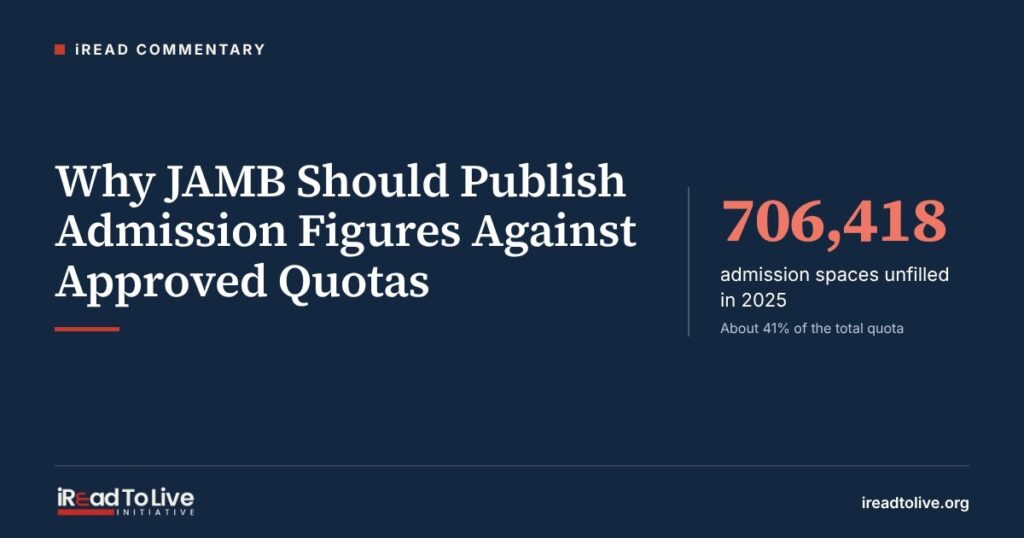
In the 2025 admission exercise, 706,418 of 1,716,154 quota spaces across Nigeria’s tertiary institutions, about 41 per cent, were left unfilled, according to figures JAMB released at its 2026 policy meeting.
The 2026/2027 admission exercise closes in three stages. Public universities must conclude admissions on CAPS by 31 October 2026. Private universities follow on 30 November, and polytechnics, colleges of education and other tertiary institutions on 31 December.
JAMB has kept to these dates, which helps prevent the admission exercise from running into the academic session. In September, CAPS was offline for about four days (96 hours) because of what JAMB described as an administrative issue with its hosting organisation. The Board restored the platform promptly, urged public universities to meet the 31 October deadline and kept all three institutional deadlines unchanged. It granted an extension only for older admissions. Candidates have until 30 November 2026 to accept or reject outstanding offers from 2021 to 2025.
iRead’s position is that JAMB should publish, at the close of the 2026/2027 admission exercise, institution-by-institution data on admission offers made and admissions accepted, measured against each institution’s approved quota. Such a record would show whether any institution admitted beyond its quota and provide a sound basis to inquire why it exceeded its granted or approved quota.
What CAPS holds when admissions close
Every legitimate admission in Nigeria is processed on CAPS. Institutions make admission offers on the platform, and candidates accept or reject them there. Each institution admits against a quota based on the carrying capacity its regulator approves for each programme.
By the end of the exercise, CAPS will hold verifiable figures for every tertiary institution, including slots approved, offers made, offers accepted and slots left unfilled. JAMB would not need to collect new data to produce them. The 28 September 2026 edition of the JAMB Bulletin sets out the deadlines for each group of institutions. If published, these figures would show Nigerians the actual carrying capacity of their tertiary institutions and how much of it each institution uses.
Why the record should be public
Candidates and parents would benefit first. They currently choose institutions with little information on how many slots each one fills or how many candidates apply for them. A published record would show which institutions admit close to capacity and which leave approved slots unused year after year.
The record would also help regulators. Admitting above quota puts pressure on lecturers, hostels and laboratories, which the NUC and the National Board for Technical Education (NBTE) assess during accreditation. With institution-level figures in the public domain, regulators, governing councils, the media and civil society organisations could check compliance without waiting for a petition.
The National Assembly also needs this information. On 22 October 2026, the Senate passed at second reading SB. 1056, a Bill for an Act to Repeal the National Universities Commission Act, Cap N81 Laws of the Federation of Nigeria, 2004, and re-enact it. Senate Leader Opeyemi Bamidele (Ekiti Central) presented the executive bill, and the Senate referred it to its Committee on Tertiary Education and TETFund for a public hearing. On the same day, the Senate passed at third reading the Federal Universities of Agriculture Act (Amendment) Bill, 2026 (SB. 899), which provides for a federal university of agriculture in Orogun, Delta State, and the Federal University of Education, Obudu, Cross River State (Establishment) Bill, 2026 (SB. 150).
Earlier, on 15 October 2026, the Senate passed a bill sponsored by Senator Muntari Dandutse (Katsina South) to establish the Federal University of Medical and Health Sciences, Funtua. A bill sponsored by Senator Ipalibo Harry Banigo (Rivers West) to establish a Federal University of Agriculture at Emughan, Rivers State, has also passed third reading and awaits concurrence in the House of Representatives. Before the National Assembly establishes more institutions or re-enacts the NUC Act, legislators should know how many approved slots existing universities leave unfilled.
Admissions are processed on a public platform managed by a public agency, and the results should be available to the public.
What JAMB should publish at the end of the exercise
At the end of the 2026/2027 admission exercise, JAMB should release the following figures for every tertiary institution.
- The approved admission quota, in total and by programme in each institution.
- Admission offers made on CAPS.
- Admissions accepted by candidates.
- Approved slots left unfilled.
- Admissions above the approved quota, if any, by programme.
JAMB should release the figures as downloadable, user-readable formats on its website for public consumption. Where the figures show admissions above quota, JAMB and the relevant regulator, whether the NUC, the NBTE or the National Commission for Colleges of Education, should apply sanctions under their existing powers and make the outcome public.
Safeguards for the record
The record should contain aggregate figures only. Candidates’ names, registration numbers and scores are personal data under the Nigeria Data Protection Act 2023, and the public interest is served by institutional totals. JAMB can therefore publish the record without disclosing any candidate’s details.
The record should also be final. Candidates may still be responding to offers made shortly before each deadline. JAMB should therefore publish a single reconciled record after the exercise closes, instead of provisional figures that change from week to week. It should also maintain a standing data release schedule. For instance, JAMB should publish the admission data two weeks after CAPS closes, and publish total registration figures two weeks after students complete registration at their institutions.
What comes next
The 2026/2027 admission exercise closes on 31 December 2026. JAMB kept its deadlines through a four-day system outage, and it is well placed to publish a reconciled, institution-level record soon after the exercise ends. Until it does, decisions on new universities will be made on incomplete information.
Jacob Sule is Executive Director of iRead To Live Initiative. iRead To Live Initiative is an independent higher education policy think tank. The findings and recommendations in this commentary are those of the author.