iRead To Live Initiative | 8 November 2026
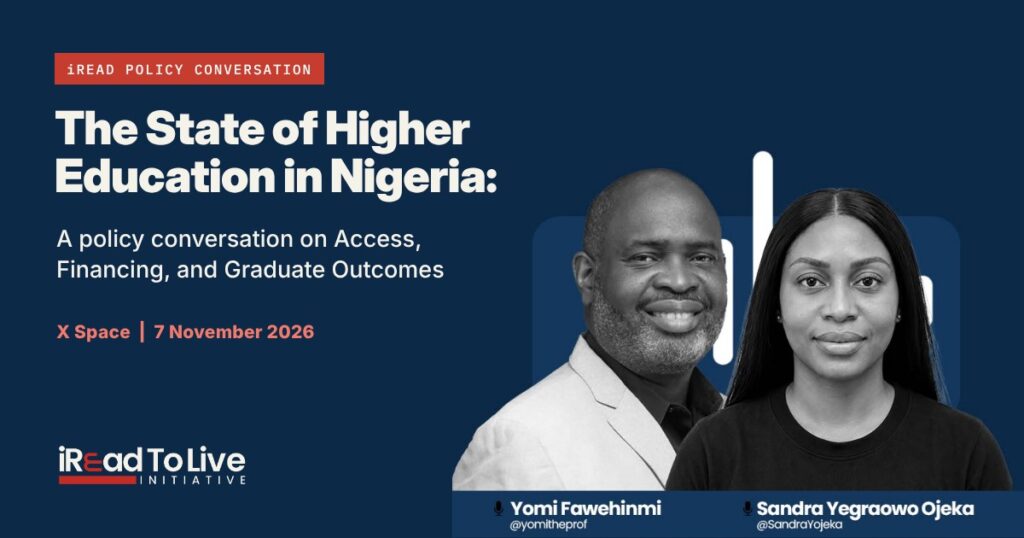
Speakers at iRead To Live Initiative’s policy conversation on The State of Higher Education in Nigeria have proposed changes to the country’s admission system, new financing models for public universities, and stronger links between what universities teach and what the country needs.
The conversation took place on X on Saturday, 7 November 2026. It featured Professor Abayomi “Yomi” Fawehinmi, an educator and HR strategist with over 30 years in higher education and a former National Council member of the Chartered Institute of Personnel Management of Nigeria, and Sandra Yegraowo Ojeka, Senior Manager, Digital Education, at a private university. Jacob Sule, Executive Director of iRead To Live Initiative, moderated. Listeners also joined the discussion with their own proposals, including Wale Micaiah (@WaleMicaiah), Chair of iRead’s Board of Trustees, Dr Olawale (@koldaf20) and Kaybee (@KB_Ozee).
The discussion comes as demand for higher education keeps rising. Nigeria now has over 300 universities, and the Joint Admissions and Matriculation Board (JAMB) recorded about two million applicants and roughly one million admissions across universities, polytechnics and colleges of education in the 2025 admission cycle.
Rethinking JAMB and the UTME
Prof Fawehinmi said JAMB now performs functions universities could handle themselves. He proposed that the West African Senior School Certificate Examination (WASSCE) serve as the qualifying examination, with the Unified Tertiary Matriculation Examination (UTME) used only to rank candidates where spaces are limited. Decisions on who qualifies for admission, he said, should rest with university Senates.
He also criticised the one-year validity of UTME results, which forces unsuccessful candidates to pay and sit the examination again. Mr Micaiah questioned whether repeat registration has turned the UTME into a revenue stream, and called for the purpose of the admission process, and of Nigerian universities, to be clearly defined.
JAMB has previously explained that UTME results are valid for one year because the examination ranks candidates for a specific admission year. Some lawmakers have called for the validity period to be extended to several years.
Widening access
Ms Ojeka focused on candidates’ preparation and access to the examination. She called for better preparation before entrance examinations, improved digital access for computer-based tests, and closer alignment between the secondary school curriculum and admission examinations. She also proposed a hybrid format with a paper-based option for candidates unfamiliar with computers, and examination centres closer to candidates, saying long journeys add to their anxiety.
Both speakers urged policymakers to recognise non-traditional learners and alternative routes into higher education. They argued that Open and Distance Learning (ODL) should be treated as a legitimate pathway, and that restrictions on some ODL graduates’ participation in the National Youth Service Corps (NYSC) discourage students from choosing it.
New universities and how to fund them
Mr Micaiah also questioned the rapid growth in new institutions, asking why they are established and what each is expected to do. The National Universities Commission (NUC) has approved dozens of new universities in recent years.
On financing, Prof Fawehinmi said Nigerian public universities were never designed to fund themselves. The discussion also covered the place of the Tertiary Education Trust Fund (TETFund) in financing higher education.
Ms Ojeka said private universities run on business-oriented models built around pricing, cost management and financial sustainability. She urged public universities to review how they spend tuition and internally generated revenue, plan around the resources their goals require, and explore public-private partnerships. Heavy dependence on government funding, she said, weakens the incentive to manage resources efficiently.
Dr Olawale called for a review of the whole system using an input-process-output framework, with attention to what happens inside institutions. He argued for comparable pay across the education sector so that teaching at every level is seen as an attractive career rather than merely a means of livelihood.
Preparing graduates for work
On graduate outcomes, Prof Fawehinmi said universities should prepare graduates for labour markets that exist and judge success by what graduates can do, not by the certificates they hold. He called for broader undergraduate programmes, a separation between academic leadership and the professional management of universities, more attention to career development, and a graduate tracking system in every university.
Ms Ojeka noted that the NUC’s Core Curriculum and Minimum Academic Standards allow universities to design 30 per cent of their curricula, but said most do not use this flexibility. She called for industry-responsive curricula, incentives for university and industry partnerships, and wider use of microcredentials so students gain additional skills alongside their degrees.
Kaybee said Nigeria must first define its national development agenda, then align university courses, teaching and research with it, rather than rely only on solutions developed elsewhere.
Five recommendations
The speakers closed with recommendations in five areas:
- Use the West African Senior School Certificate Examination (WASSCE) as the qualifying examination for admission, limit the UTME to ranking candidates, and extend the validity of UTME results beyond one year.
- JAMB should offer a paper-based option and bring examination centres closer to candidates.
- Policymakers should recognise Open and Distance Learning as a full pathway into higher education, including for NYSC.
- Public universities should review how they spend tuition and internally generated revenue and explore public-private partnerships.
- Every university should track its graduates, use the 30 per cent curriculum flexibility the NUC already allows, and build partnerships with industry.